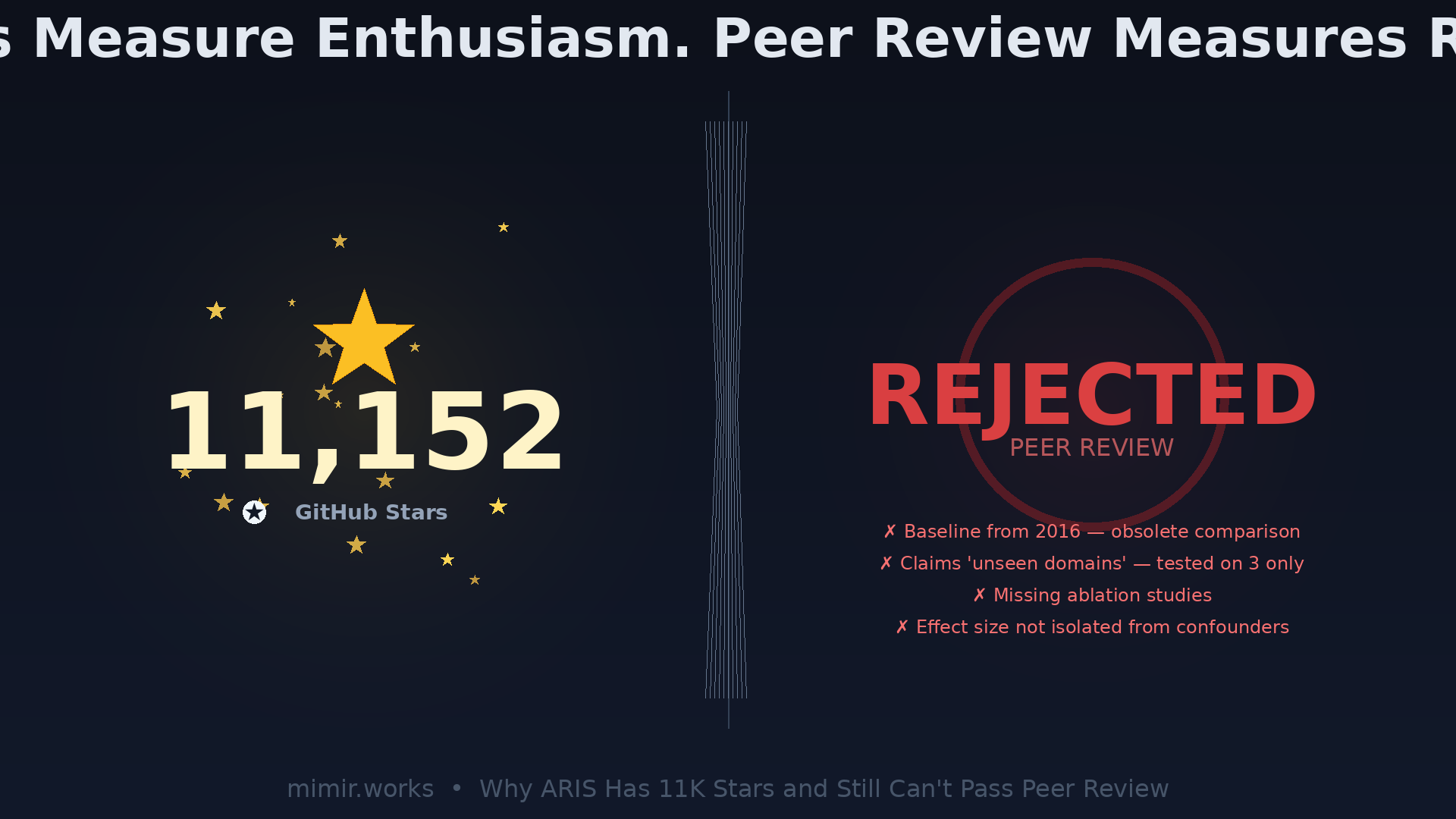
ARIS is the most visible autonomous research agent on the open-source circuit. The demos are genuinely impressive: drop in a research question and watch it chase citations across arXiv, Semantic Scholar, and paper search APIs, then synthesize a structured answer with sources.
I watched those demos. ARIS is good at what it does. The open-source community did not star it by accident.
But here is the gap nobody is solving: discovery is not rigor. Finding a paper is not the same as passing peer review, and that is where AI agent peer review falls apart. ARIS gets you to the paper faster than any human researcher. What happens after that: the actual work of critique, baseline verification, claim-to-evidence matching, and structured grading. That is where every autonomous research agent I have tested breaks down.
The Star Count Trap
Stars measure enthusiasm, not accuracy. They track how fast a project goes viral, not whether the conclusions it draws hold up under scrutiny.
ARIS deserves the attention. Autonomous multi-source discovery, structured synthesis, trend detection across a corpus: these are real advances. The project solved a genuine bottleneck: researchers spend hours finding relevant papers, and ARIS collapses that to minutes.
But the metric that matters in research is acceptance rate. Not GitHub stars. Not viral demos. Whether a human reviewer with domain expertise reads your summary, checks your work, and passes it.
I have been on both sides of peer review. I have written papers that were desk-rejected for baseline inadequacy before a human ever read the introduction. I have reviewed submissions where the agent-generated summary looked polished and the actual analysis was hollow. The gap between "found the paper" and "passed review" is where most AI research agents die, and ARIS is no exception.
The star count is a signal, not a verdict. What it signals is that researchers want autonomous tools. What it does not signal is that those tools are ready to replace the reviewer's role.
What ARIS Gets Right (And Why It Matters)
Let's be precise. ARIS solves real problems that I have personally wasted hours on.
Autonomous discovery. It queries multiple sources without human intervention, follows citation chains, and surfaces papers a manual keyword search would miss. This is not trivial. Discovery is a skill, and ARIS is good at it.
Structured synthesis. It does not just dump abstracts. It organizes findings by topic, method, and claim, which is more than most agents manage.
Trend detection. ARIS spots citation patterns across time. That is legitimate insight work, and it saves human researchers hours of manual scanning.
The ARIS community is not wrong. The problem is not that ARIS exists. The problem is what researchers expect to happen after ARIS hands them a paper list. They expect synthesis to equal critique. It does not.
If you are building with ARIS, you should treat it as the first phase of a pipeline, not the whole pipeline. It finds. You still need to verify. And verification is where the agents fail.
The Three Failure Modes of AI Research Agents
I have tested autonomous research agents against real peer-review standards. These are the criteria NeurIPS, ICML, and ACL reviewers apply without exception. Every agent I tested failed in the same three ways. ARIS would fail the same way because the problem is structural, not specific to one tool.
Failure Mode 1 - Baseline Inadequacy
AI agents quote baselines from 2017. They don't verify whether the claimed improvement is against current SOTA or a straw man. A real peer reviewer flags this in the first pass.
Concrete example, invented but representative of what I have seen agents produce:
"The paper achieves +2.3% accuracy on ImageNet-C robustness benchmarks."
The agent cites that as a positive result. The baseline is ResNet-50 from 2016. Current SOTA on ImageNet-C is ConvNeXt V2 and newer architectures. The "improvement" is against history, not against the field. A real reviewer would flag this as baseline inadequacy: comparing against an obsolete competitor to inflate the gain.
Agents don't catch this because they don't maintain a living baseline table. They read what the paper says and repeat it. Peer review exists precisely because papers say things that don't hold up.
The difference between a good researcher and a good agent, at this stage, is that the researcher knows what the current SOTA is. The agent only knows what the paper told it.
Failure Mode 2 - Claim Verification Without Grounding
Agents summarize claims confidently. They don't check whether the evidence supports the scope.
These are structural gaps, not edge cases. A claim like "generalizes to unseen domains" tested on three domains is not a minor footnote. It is a scope mismatch that undermines the entire contribution. An agent that faithfully summarizes the claim without measuring it against the evidence is doing transcription, not review.
Examples I have seen in agent-generated reviews:
"The method generalizes to unseen domains."
Tested on three domains. Three domains is not "unseen domains." Three domains is three domains.
"Robust to adversarial attacks."
Tested at epsilon = 0.03 on PGD. That is one attack, one epsilon, one threat model. "Robust to adversarial attacks" implies a scope the evidence does not support.
The agent summarized the claim faithfully. It did not ask whether the evidence matched the scope. That question is the whole job of claim verification, and agents skip it because their optimization function is synthesis, not audit.
This is the research rigor gap in one move: the agent believes what it reads because it has no mechanism for doubt.
Failure Mode 3 - The Missing Limitations Section
No AI agent voluntarily writes "our approach has these five flaws."
Peer reviewers live in the limitations section. It is where honest science happens. Every real paper has a limitations section where authors acknowledge what they didn't test, what assumptions they made, and what could break their conclusions.
Agents skip limitations because they are optimized to please, not to audit. An agent that produces a limitations section is usually doing one of two things: either it paraphrases whatever limitations the original authors included (which is not critique: it's transcription), or it fabricates plausible-sounding limitations that don't correspond to actual methodological failures.
A real reviewer reads the methodology and generates limitations the authors did not think to include. That is the value of independent review, and it is the hardest thing to automate.
I wrote about this structural problem in the context of coding agents, where an agent reviewing its own output is confirmation bias wrapped in a test suite. The same principle applies here. An agent synthesizing research from sources it found is grading its own homework. It cannot surprise itself in a productive way.
What a Fail-Closed Methodology Looks Like
Peer review is inherently fail-closed: assume every claim is overstated until proven otherwise. Current AI research agents (ARIS included) are fail-open: assume correctness until someone flags a problem. The gap between these two modes is what I call the AI agent peer review crisis: we built tools that find, and forgot to build tools that audit.
Safety engineering calls these modes fail-closed (block by default) and fail-open (allow by default). A research agent that synthesizes confidently without auditing is fail-open. It ships summaries that sound true and are not.
What would a fail-closed research methodology look like? I have worked through this with actual reviewer workflows. Here is the five-phase pipeline I use:
Phase 1: Methodology audit. Does the paper actually do what the abstract claims? Read the method section before the results. If the abstract says "generalizes" and the method tests on three domains, the audit flags a methodology mismatch. Methodology mismatch is an automatic red flag.
Phase 2: Baseline adequacy. What is the comparison baseline and is it current? If the paper compares against a 2016 architecture in 2026, the review notes baseline inadequacy before reading the improvement numbers. The numbers don't matter if the comparison is unfair.
Phase 3: Claim-to-evidence verification. Map every claim in the abstract and conclusion back to the evidence in the results. Scope inflation ("all" when the evidence is "some," "robust" when the evidence is "tested once") gets flagged explicitly. Limitations are extracted during this phase, not appended as an afterthought.
Phase 4: Significance assessment. Is the effect size meaningful? A 0.2% improvement with p < 0.05 is statistically significant and practically irrelevant. Real reviewers distinguish those. Agents conflate them.
Phase 5: Structured grade. Assign a NeurIPS-style letter grade with actionable notes: "Weak accept - baseline is fair but scope claims need narrowing." This is not a score. It is a decision with reasoning attached.
This pipeline is what the evaluation scorecard I use for agent tasks looks like when applied to research. Real evaluation requires evidence, constraints, and failure mode analysis. Not vibes and synthesis.
A fail-closed agent would run this pipeline before generating any summary. It would block on Phase 1 or Phase 2 failures rather than synthesizing around them. It would produce shorter, more honest outputs. And it would be less impressive in a demo, which is why nobody builds it that way.
That gap is the unsolved problem. Discovery is solved. Critique is still manual. You can read the full evaluation framework here if you want to apply it to your own agent workflows.
The Rigor Gap Is the Opportunity
The market has solved discovery. Elicit, Consensus, SciSpace, Perplexity: all find papers faster than humans. The discovery layer is competitive and mature.
Nobody has solved rigor. That is the gap.
I said earlier that ARIS would fail peer review. That is not an attack on ARIS. It is a description of the state of the field. Every autonomous research agent I have tested fails on baseline verification, claim scope, and limitations identification. ARIS has stars because it does discovery well. It would fail review because it does not do critique.
The opportunity is not a competitor to ARIS. It is a rigor layer for any agent that finds papers. ARIS got you the papers. The question is whether you can get past the reviewers.
That rigor layer already exists as the ARIS Research Pack: fail-closed research skills for Claude Code, Cursor, Codex, and OpenCode. The five-phase pipeline above is built into the pack, along with templates for baseline adequacy checks, claim-to-evidence mapping, and structured grading.
This is the same pattern I see in other agent failure modes: silent message drops where the system reports success but the work never happened, or agents reviewing their own code and missing structural flaws. The gap between "looks correct" and "is correct" is where AI agents need human-grade skepticism, and where tool builders have the most room to build value.
The researchers who will win are the ones who combine ARIS's discovery speed with fail-closed critique discipline. They will find papers faster and review them better than teams relying on either one alone.
From Stars to Submissions
ARIS will keep climbing. It should. Discovery is a real problem and ARIS is a real solution.
But the researchers who separate discovery from rigor (who recognize that star counts measure enthusiasm, not quality) are the ones who will ship publication-grade work.
Stars get you attention. Rigor gets you published.
Get the ARIS Research Pack - $149 one-time. Fail-closed research skills for Claude Code, Cursor, Codex, and OpenCode. Install in 5 minutes. First peer-grade review in 15.