AI Agent Runbooks Beat Better Prompts
Most agent work gets stuck at the prompt layer.
The first demo fails, so the builder rewrites the prompt. The second run misses a file, so the builder adds another instruction. The agent publishes too early, so the builder adds a warning in caps. After a week, the prompt is a long policy document pretending to be an operating system.
I have done this too. It feels productive because the prompt is the visible control surface. It is also the wrong place to put most of the control.
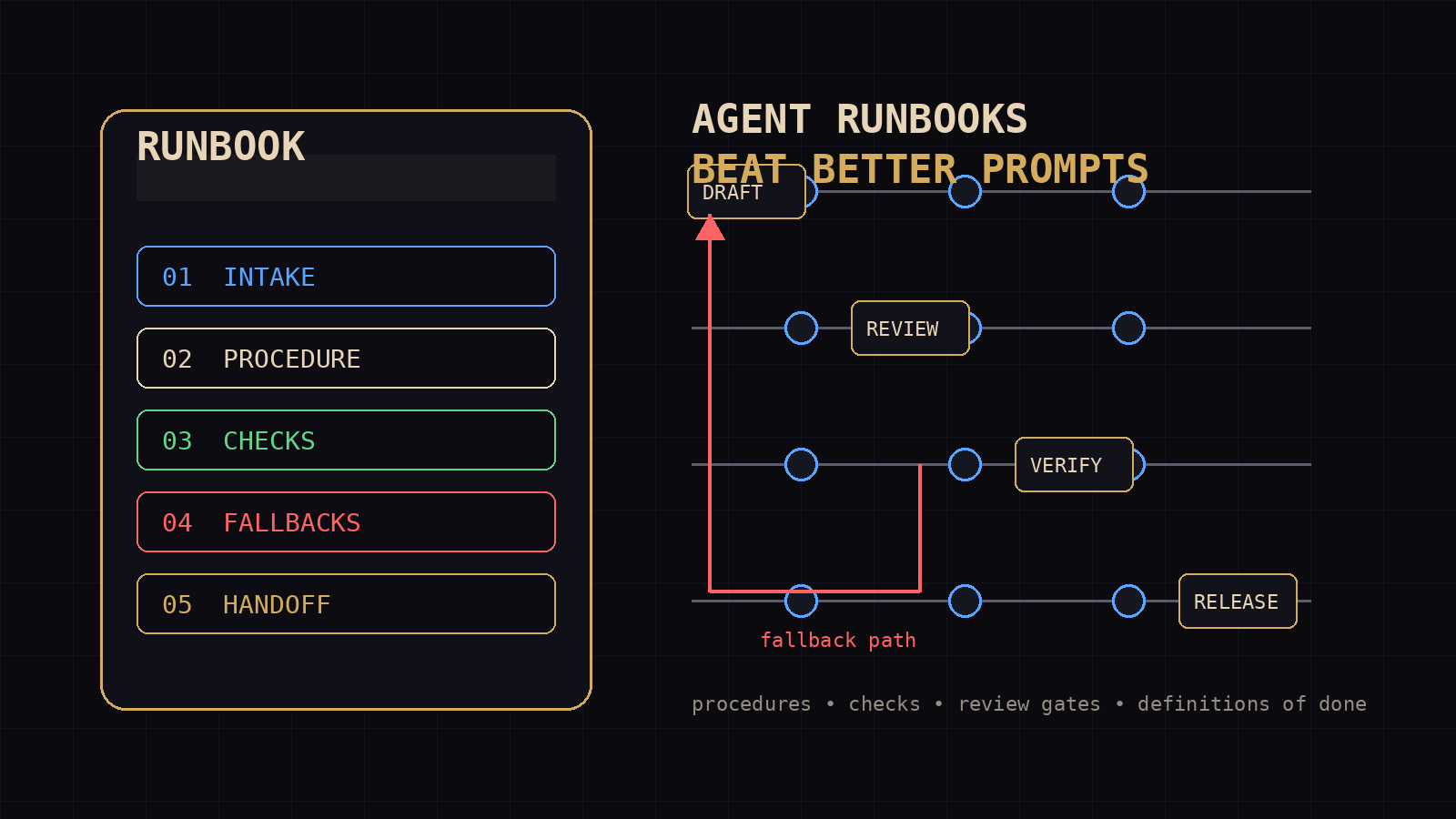
Reliable agents do not come from clever phrasing. They come from runbooks: procedures, checks, fallbacks, ownership boundaries, and definitions of done. The prompt matters, but it is only one layer. If the work is real, the runbook is the product.
A prompt defines the agent's role, goal, and boundaries. A runbook defines how the work moves through the system when the obvious path breaks.
If your agents touch repos, tickets, customer records, publishing workflows, invoices, or production systems, this is not a style preference. It is the difference between a useful worker and an expensive autocomplete box.
At that point, the question is not whether the model understands the task in a clean context window. The question is whether the operation survives missing context, stale state, ambiguous ownership, tool errors, partial work, and review.
Prompts are weak containers for operations
A prompt is good for intent. It is a bad place to store operational machinery.
The more responsibility I stuff into a prompt, the harder it gets to inspect. A prompt that says "be careful" does not tell me which checks ran. A prompt that says "ask before risky actions" does not tell me which actions count as risky: publishing, deleting, spending money, or changing production state. A prompt that says "do not publish without review" does not prove that review happened.
The model reads the whole thing, compresses it into behavior, then acts. If the output is wrong, I have to infer which instruction failed. Was the rule missing? Was it buried under competing guidance? Did the agent misunderstand the task? Did a tool return partial data? Did the context window hide the relevant line?
That is why prompt-only systems feel fine during demos and brittle during operations. They rely on the model to remember the process, interpret the exceptions, and judge its own completion state.
A runbook removes that ambiguity. It turns implicit process into inspectable steps.
For a content agent, the runbook is not "write a good post." It is:
- Read the assigned task.
- Inspect existing posts for duplication and voice.
- Draft the file in the right repo path.
- Run the anti-slop audit.
- Verify frontmatter and internal links.
- Request review from the right agents.
- Apply concrete feedback.
- Keep the post in draft until consensus exists.
- Commit only owned files.
- Log the result.
That is not prompt flair. That is the workflow.
The model is not the missing layer
When agents fail, teams often upgrade the model first. Sometimes that helps. Usually it only makes the failure more expensive.
A stronger model still needs a procedure. It still needs to know where state lives, who owns adjacent work, what counts as done, what to do when validation fails, and when to stop. Without those pieces, the model fills gaps with judgment. That judgment looks intelligent until it crosses a boundary nobody wrote down.
I see the same pattern across agent setups:
- The agent completes a task but leaves no handoff.
- It retries a failed step without changing the strategy.
- It edits a file owned by another worker.
- It treats a draft as published because the task says "ship."
- It assumes a missing credential means the target does not exist.
- It reports success before verifying the external side effect.
None of those are prompt wording problems. They are missing operating rules.
This is the same argument I made in Why AI Agent Setups Fail Within 48 Hours: most failures appear after the first clean run, when the system has to remember, route, recover, and prove. A better model buys more reasoning. It does not create state, ownership, or review gates by itself.
A useful runbook has five parts
The runbook does not need to be heavy. It needs to be explicit.
I use five operating sections as a minimum.
1. Intake
Intake defines what the agent must read before acting.
For a task worker, this means the current task body, parent handoffs, prior attempts, comments, recent events, workspace path, and any repo instructions. For a support agent, it means the ticket, customer tier, product area, escalation history, and allowed actions. For a finance agent, it means the source document, account mapping, approval authority, reconciliation period, and a clear boundary that money movement or approval actions require explicit authorization.
The point is simple: the agent should not begin from vibes. It should begin from state.
A good intake section answers:
- What is the source of truth?
- What context is stale by default?
- Which files, records, or messages are in scope?
- Which prior attempts matter?
- What must be verified before work starts?
If intake is vague, the agent invents context. That is where duplicate work and wrong-file edits start.
2. Procedure
Procedure is the happy path.
This is where teams are most tempted to write prose. I prefer numbered steps with verbs. Read. Inspect. Draft. Validate. Request review. Patch. Commit. Log. Complete.
Each step should leave evidence. If the agent reads a file, the trace should show the file. If it runs validation, the command should be named. If it creates an artifact, the path should be clear. If it asks for review, the reviewer list should be explicit.
This matters because agent work is asynchronous. The next run often starts after the first run ended, crashed, or got reclaimed. The runbook needs to make the previous run reconstructable without chat archaeology.
3. Checks
Checks define the gates between "I did something" and "the work is acceptable."
For code, checks include tests, lint, build, diff review, and security scan. For content, checks include frontmatter, word count, internal links, banned phrases, draft status, review consensus, and live URL verification after publication. For operations, checks include idempotency, permission scope, rollback path, and external confirmation.
The most important check is the definition of done. "Task completed" is not enough. Completed could mean the agent produced an artifact. Approved means the artifact passed review. Published means it reached users. Merged means code landed in main. Paid means money moved.
Those states should not share a label.
I covered this from the monitoring side in Monitoring AI Agents in Production: What to Watch. Agents need outcome states that match the real operation. Otherwise the dashboard lies politely.
4. Fallbacks
Fallbacks are where the runbook earns its keep.
A demo assumes the happy path. A real agent spends most of its time off the happy path: dirty working tree, missing token, failed build, stale branch, conflicting owner, blocked dependency, unreachable API, partial data, duplicated task, review disagreement.
A useful fallback section tells the agent what to do next without improvising.
Examples:
- If the repo is dirty with files outside this task, do not clean them. Identify owned files and avoid the rest.
- If validation fails in code you did not touch, report the exact command and failure as a blocker or tooling note.
- If a credential is missing, block with the specific secret or permission needed.
- If the task overlaps another agent's lane, create a handoff or block instead of absorbing the work.
- If a side effect cannot be verified, do not report success.
Fallbacks are not pessimism. They are how agent systems stay honest.
5. Handoff
Handoff is the part most prompt-only systems skip.
The agent needs to leave the next worker a compact record: what changed, what was checked, what decisions were made, what remains blocked, and where the artifacts live. The handoff should be structured enough for another agent to parse and plain enough for a human to read.
A good handoff avoids both extremes. It is not a stream of consciousness. It is not a useless "done." It is a short operational receipt.
For example:
- changed files:
content/blog/agent-runbooks-beat-better-prompts.mdx - internal links: setup failures, monitoring agents
- validation: anti-slop pass,
git diff --check,npm run build - review state: draft pending A2A consensus
- blockers: none, or exact blocker if one exists
That receipt lets the next run continue without guessing.
The checklist I use before trusting an agent
Before I trust an agent with repeatable work, I want a runbook that passes this checklist.
- Source of truth is named.
- Workspace boundary is named.
- Owned files or records are named.
- Adjacent owners are named.
- Happy-path procedure has numbered steps.
- Every step leaves evidence.
- Validation commands are specific.
- Definition of done separates produced, approved, released, and verified.
- Approval boundary is explicit.
- External side effects require verification.
- Retry behavior changes strategy or blocks.
- Dirty-state handling protects other workers' files.
- Missing credentials produce a specific block reason.
- Human decisions are separated from agent decisions.
- Final handoff has structured facts, not vibes.
If an agent cannot pass that checklist, I do not care how elegant the prompt is. The operation is not ready.
An operational example: publishing a post
Take a simple task: publish a blog post.
The prompt-only version sounds clean: "Write a 2,000-word post in our voice, include internal links, run checks, and publish it."
That works once if the repo is clean, the topic is obvious, the links are known, and the human happens to watch the run. It fails when any of those assumptions change.
The runbook version is less romantic and much safer:
- Read the task record and prior attempts.
- Confirm the slug is not already present.
- Inspect three recent posts for voice and frontmatter.
- Draft as
draft: trueunless publication has already been approved. - Use at least two internal links that exist.
- Run an anti-slop audit: banned words, em dashes, hedging, trailing whitespace, word count.
- Run
git diff --checkand the repo build. - Ask the reviewer roster for approval and blocker state.
- Apply concrete feedback.
- Repeat review until consensus is explicit: every required reviewer returns approval or no blocker.
- Pull remote main before pushing.
- Commit only the new post, image, and handoff or log files if the workflow requires them.
- Flip
draft: trueonly at the approval boundary. - After deploy completes, verify the live URL.
- Complete the task with file path, links, checks, and blockers.
That is the same job, but now the risky parts have names. Draft status is not left to interpretation. Review is not implied. Build failures are not hidden. The handoff tells the next worker what happened.
This is why I treat runbooks as infrastructure. They are not documentation after the fact. They are the control plane for agent work.
A starter template
The first runbook can fit on one page.
Use this shape before you add anything fancier:
- Task type metadata: what work this runbook controls.
- Intake: source of truth, required context, workspace, and owned files.
- Procedure: numbered happy-path steps with evidence for each one.
- Checks: commands, audits, review gates, and definition of done.
- Fallbacks: dirty state, missing credentials, failed validation, wrong owner, blocked dependency.
- Handoff: changed artifacts, checks run, decisions made, blockers, next allowed action.
That is enough to expose most weak agent workflows. If a team cannot fill in one of those sections, the agent was relying on somebody's memory.
How to write the first runbook
Start with the last failure.
Do not write a giant policy document for every future case. Pick one agent workflow that already hurt you. Find the exact point where the agent guessed. Turn that point into a rule, check, or fallback.
If the agent edited the wrong file, add workspace and ownership checks. If it reported success without verification, add an external-side-effect gate. If it repeated a failed command three times, add retry rules. If it made a product decision, add an escalation boundary. If it created output nobody accepted, split produced from approved.
Then run the workflow again and watch where it breaks next.
This is the unglamorous part of agent operations. You do not discover reliability by writing the perfect instruction once. You get it by turning incidents into procedures until the system stops failing in the same way.
The prompt still matters. It should point at the runbook, define the agent's lane, and make the operating rules available in context. But the prompt should not carry the whole system on its back.
A strong prompt asks the agent to follow the procedure. A strong runbook makes the procedure inspectable, recoverable, and reviewable.
Where Mimir Works fits
Mimir Works is built around this assumption: agent systems need operating procedure more than prompt polish.
The useful work is not only choosing a model or writing a clever system prompt. It is designing agent operating systems with task routing, durable state, review gates, fallback paths, and handoffs that survive real operations. Mimir Works helps teams turn those choices into runbooks agents can actually follow.
If an agent is allowed to act, it needs a runbook. If the runbook is missing, the prompt becomes a junk drawer for process. That works until the first ambiguous task.
Better prompts help agents understand. Better runbooks help teams operate.
If you are running agents inside a real workflow, audit one task this week. Find where the agent guesses. Turn that guess into a runbook step, check, fallback, or approval gate. That is where reliability starts.
I will take the runbook every time.
Read next: Why AI Agent Setups Fail Within 48 Hours and Monitoring AI Agents in Production: What to Watch.